Most freelancers start with the wrong mindset. They treat freelancing like a job, not like a business. They focus on completing tasks, chasing clients, and hoping for consistent income at the end of the month.
But freelancing does not work like traditional employment. There is no fixed salary, no guaranteed structure, and no predefined path. Freelancing is a business model, and if you do not treat it that way, you will stay stuck in inconsistency.
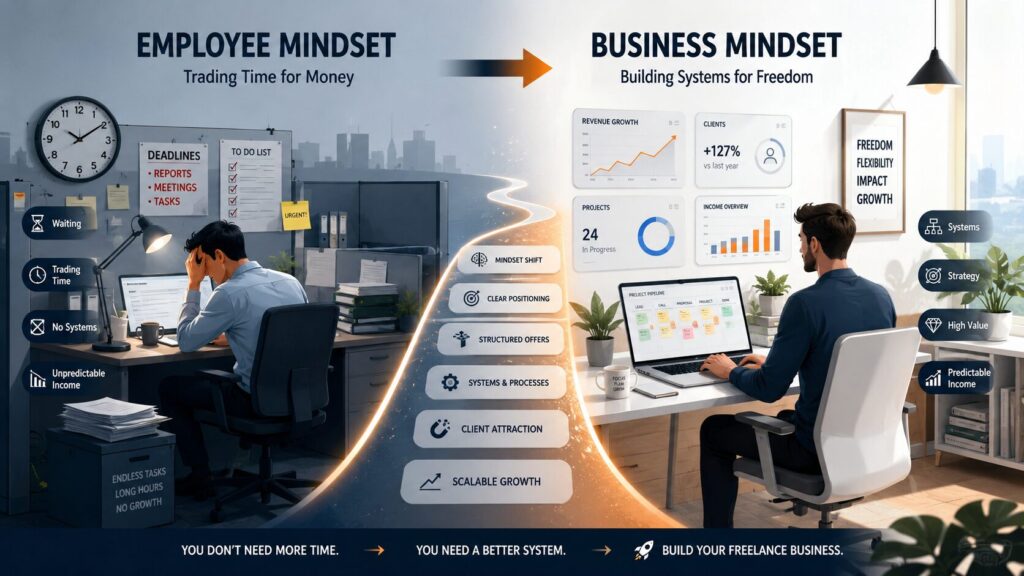
The problem with the employee mindset
The biggest mistake freelancers make is that they continue thinking like employees.
They wait for work instead of building systems that bring work to them.
They accept any project without strategy or positioning.
They focus on hours worked instead of value created.
They do not build any predictable client acquisition system.
In this model, you are not building a business. You are only exchanging time for money.
What freelancing as a business actually means
When you treat freelancing like a business, everything changes.
You build a clear system for attracting clients.
You define exactly who your ideal client is.
You create offers instead of just listing services.
You focus on positioning in the market instead of just showing a portfolio.
You optimize for revenue instead of being constantly busy.
At that point, you are no longer just working. You are running a system.
Systems matter more than talent
Many freelancers believe that talent is enough to succeed. In reality, talent without systems does not scale.
The most successful freelancers are not always the most skilled. They are the ones who have systems in place for:
Marketing
Sales
Communication
Service delivery
Without systems, even a highly skilled freelancer stays invisible in the market.

Why most freelancers stay stuck
There are three main reasons why freelancers struggle to grow:
No clear positioning, and trying to serve everyone
No structured offer, only random services
No marketing system, and relying on luck or referrals
Because of this, income stays unstable regardless of experience or effort.
What a real freelance business looks like
A freelancer who runs a business thinks differently.
They do not ask how many hours something takes, they ask what value it creates.
They do not chase clients; they attract them.
They do not post random content; they build a structured system.
They do not react to opportunities; they design them.
Their goal is not to stay busy. Their goal is to stay profitable and scalable.
Conclusion
Freelancing can give you freedom, but only if you treat it like a business system.
If you treat it like a job, you will always depend on clients to give you work.
If you treat it like a business, you control your income, your clients, and your growth.
The difference is not in what you do. The difference is in how you think.